
The world's largest social platform Telegram has a major update: Your GPU can now mine TON.

 Prefer us on Google



Yesterday, Telegram founder Pavel Durov tweeted to announce that their decentralized privacy computing network, Cocoon, has officially launched.

The Cocoon network consists of 3 parts:
Client: Initiates work requests to the agent and pays the agent upon request completion.
Agent: Routes work requests to work nodes. The agent, protected by TEE, will select an appropriate node based on the device model, load, and reputation of the work node, and will transfer the fee collected from the client to the node, which will also deduct a certain commission. Telegram plans to allow anyone to run their own agent in the future, making the Cocoon network fully decentralized.
Work Node: Executes AI inference requests in a TEE-protected virtual machine and is paid by the agent the fee from the client upon completion of the execution.
In other words, anyone can become a work node with their GPU to earn $TON. Cocoon enables GPU owners to contribute AI computing power to the decentralized network on TON by running the Cocoon protocol stack on a TEE-supported GPU server, providing private, verifiable AI model execution, and transparently receiving $TON payment for each processed request.
Pavel Durov stated that some AI-related features of Telegram, such as message translation, are already partially supported by Cocoon. He also mentioned Telegram's in-app features like speech-to-text and summarization, indicating that Cocoon initially lacks practical applications and believes that Telegram mini-programs will bring more demand for the Cocoon network in the future.
Compared to the previously hyped Telegram gift NFT in the crypto community, Cocoon is more like a decentralized AI computing network built by Telegram integrating blockchain and $TON as a payment method, stemming from the functional requirements within Telegram, with limited hype potential as it is unlikely to issue a coin. However, this project may reflect a long-term trend where there is increasing attention to the privacy concerns of exposing data directly to centralized AI giants when using AI. In the crypto community, we have seen more and more projects in the privacy track advocating for "protecting data sovereignty." (Related Read: 12 New Projects, an Overview of the Privacy Projects Officially Recognized by Solana)
Currently, the total TVL of the Cocoon Network has reached around 4487 TON, with 30 working nodes, 18 delegates, and 12 clients. This data is from just over 1 day since its official launch, still very early.
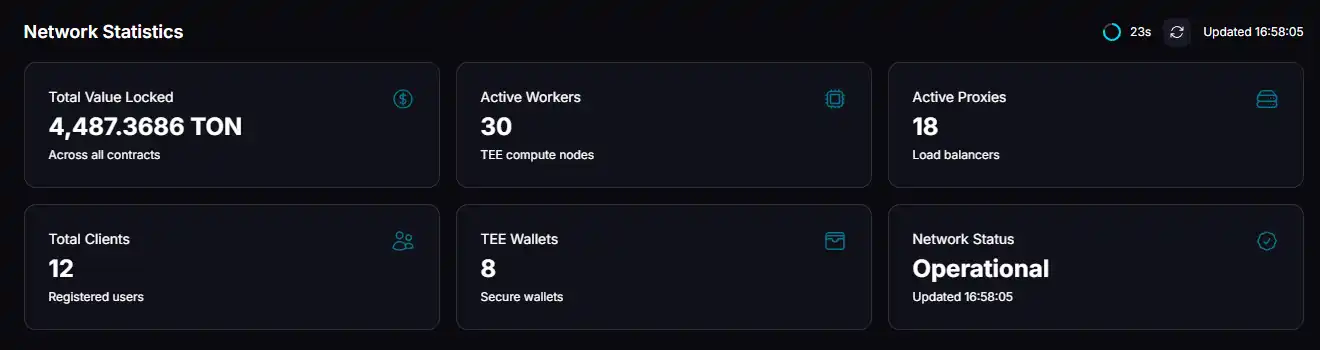
There is practical application demand supported by Telegram's built-in features and TON incentives. However, due to the presence of TON incentives, the expectation of coin issuance has also been reduced. Whether the Cocoon Network can follow a development pace different from that of typical cryptocurrency projects in the industry remains to be seen and will require time to validate.
Disclaimer: This content is provided for general branding and informational purposes only and doesn't constitute financial, investment, legal, or tax advice. Any events, rewards, online events, or related information mentioned herein should not be considered a recommendation, solicitation, or invitation to purchase, sell, trade, or otherwise deal in any crypto assets or to use any services. Crypto assets are highly volatile and may result in loss. WEEX services and online events may not be available in all regions and are subject to applicable laws, regulations, and eligibility requirements. You are responsible for ensuring that your use of WEEX services complies with local laws and for carefully assessing the risks before participating in any crypto-related activities.
You may also like

Porto Sudeste: The $5 Billion M&A Attracting BlackRock and Vale

SLC Agrícola Reduces Land Purchase and Eases Cash Pressure

Pakistan seeks crypto dialogue after scholar rejects USDT payments

Crypto in Agriculture: Financial Sovereignty Triumphs Over Banking Bureaucracy

How to Make Product Ads With AI for TikTok and YouTube—For (Almost) Free

Thailand targets high-value USDT trades in grey capital crackdown

BlackRock’s BUIDL hits $900M on Avalanche as RWA race grows

Bitcoin Policy Institute Tackles Massive Theft of Digital Wallets

What is the Smart Rebalance Bot and How Does it Help Traders?
BlackRock and VanEck Revive Bitcoin ETF Momentum with Massive Capital Inflow
Reflecting on Vitalik and Aya's Conversation in Hong Kong: The Ethereum Ecosystem is Entering a Multi-Node Future

Kiyosaki: Only Gold, Silver, Oil, and Bitcoin Will Survive the Next Crash
SBI bets $76M on EDX as institutional crypto race heats up

New Hampshire Rejects $100 Million Bitcoin-Backed Bond Proposal, Republican Lawmaker Slams Short-Sightedness

QIZ Security Secures $17 Million in Seed Funding to Accelerate Post-Quantum Encryption Governance Platform

Jamie Coutts: Bitcoin Approaches the Final Stages of the Bear Market

Ethereum Foundation May Evolve into a 'Mascot'? Diversified Organizations Are Taking Over Its Functions

Multicoin Partner Dialogue: Crypto Market Has Hit Bottom, Three Cryptocurrencies to Watch in This Cycle

Ripple is regulated in Europe before it is classified in America: inside the Luxembourg license

Nokia and AI: How the Cell Phone Manufacturer Reborn in Data Centers
The U.S. CBDC Ban Until 2030 Will Take Effect Without Trump's Signature
Tangem: the risk of laser attacks is "virtually nonexistent"

Crypto IPO market stalls as capital rotates to AI and macro uncertainty weighs

Living in Europe Puts a Target on Your Back for Having Bitcoin

Nano Banana 2 Lite vs. Nano Banana 2: When to Save Your Money and When to Upgrade

Royalty Automation: Is the Market Dispensing with State Bureaucracy?
Haddad Attacks Selic at 14.25%: What Changes in the Fiscal Debate
S&P 500 Earnings in Q2 2026: Highest Increase in 5 Years
Pantera Capital: As Perpetual Contracts Move to Financial Centers, Hyperliquid Aims to Embrace All

Bitcoin: Ki Young Ju Sees a Rebound in the Coming Months
Porto Sudeste: The $5 Billion M&A Attracting BlackRock and Vale
SLC Agrícola Reduces Land Purchase and Eases Cash Pressure
Pakistan seeks crypto dialogue after scholar rejects USDT payments
Crypto in Agriculture: Financial Sovereignty Triumphs Over Banking Bureaucracy
How to Make Product Ads With AI for TikTok and YouTube—For (Almost) Free
Thailand targets high-value USDT trades in grey capital crackdown

Contents
Latest articles






Latest coin listings on WEEX


