
How to Make Money on Prediction Markets: Strategies, Risks, and What WEEX Users Should Know

 Prefer us on Google


KEY TAKEAWAYS
Prediction markets allow traders to buy and sell contracts tied to future outcomes, such as elections, economic data, sports results, policy decisions, or crypto milestones. A trader makes money only when their view of probability is better than the market price after fees, spreads, liquidity conditions, and resolution risk are considered. Users who want access to standard crypto markets can register on WEEX, while treating prediction markets as an external education and sentiment topic rather than a WEEX trading product.
The basic idea is simple: if a contract implies a 40% chance of an event, but your research suggests the true probability is closer to 55%, the market may be mispriced. However, being right about the direction is not enough. You also need the trade size, timing, liquidity, and exit plan to work in your favor.
Prediction markets can be useful for information discovery, but they are not a shortcut to easy income. Thin markets, legal restrictions, biased trader pools, sudden news, and unclear settlement rules can turn a good thesis into a poor trade.
For beginners, the safer approach is to study probability, start with small positions, avoid emotional bets, and compare market odds with independent research before risking real capital.
What It Means to Make Money on Prediction Markets
Making money on prediction markets usually means buying contracts when the market price is below your estimated probability, or selling contracts when the price is above your estimated probability. If an outcome contract trades at 35 cents, the market is roughly pricing a 35% chance before considering fees and spreads. If the event resolves as true, that contract may pay out at 1 dollar. If it resolves as false, it may go to zero.
This probability-based structure makes prediction markets different from ordinary spot trading. You are not simply asking whether price will go up or down. You are asking whether the market has assigned the correct probability to a future event. The edge comes from better information, better interpretation, or better discipline than the average trader in that specific market.
For crypto users, this framework may feel familiar because it still involves liquidity, order books, volatility, and risk control. The difference is that the underlying driver is not only price action. It is the final resolution of a real-world or on-chain event.
Strategy 1: Find Mispriced Probabilities
The most direct way to profit from prediction markets is to find prices that do not match reality. For example, a market may underprice a political candidate because traders are reacting to social media narratives rather than polling, fundraising, turnout models, or district-level data. A crypto market may underprice a protocol milestone because traders have not read the latest governance update or development timeline.
This does not mean every disagreement is an opportunity. You need a reason the market is wrong and a reason it may correct. A strong trade thesis usually explains three things: what the market price implies, what your independent probability estimate is, and what information gap creates the difference.
Beginners should write this down before entering a trade. If the only reason for buying is that the payout looks large, the position is probably speculation rather than probability trading.
Strategy 2: Trade News Faster, But Carefully
Prediction markets often move quickly when new information appears. Court rulings, campaign news, economic releases, exchange listings, protocol upgrades, or regulatory announcements can change probabilities within minutes. Traders who understand the event faster than the crowd may capture short-term price movement.
The risk is that fast news trading can become reactive and emotional. A headline may look important but have little effect on the final outcome. A rumor may move prices before being corrected. A thin market may jump sharply and then reverse when larger traders arrive.
A practical approach is to separate confirmed information from interpretation. Confirmed information tells you what happened. Interpretation tells you how much it should change the probability. Profitable traders are usually better at the second step, not just faster at reading headlines.
Strategy 3: Buy Low, Sell Before Resolution
Not every prediction market trader waits until the event resolves. Some traders aim to buy a contract when sentiment is low and sell after the probability reprices higher. This is similar to swing trading, except the asset is an event probability instead of a token or stock.
For example, if a market moves from 30% to 55% after new data, a trader may lock in gains instead of holding to the final outcome. This can reduce resolution risk, especially when the event is still uncertain or the final rules are complicated.
The trade-off is that exiting early can leave money on the table if the contract later resolves in your favor. Beginners should decide before entering whether the goal is to trade the probability move or hold through final settlement.
Strategy 4: Use Hedging and Portfolio Thinking
Prediction markets can also be used as hedging tools. A trader who has exposure to crypto regulation risk may watch political or policy markets as external signals. A trader who owns assets sensitive to interest rates may monitor markets around central bank decisions, inflation data, or election outcomes.
This does not mean prediction markets should replace normal risk management. Instead, they can add another layer of information. If market odds begin pricing a regulatory or macro shift, crypto traders may compare that signal with BTC volatility, funding rates, liquidity, and broader market sentiment.
WEEX users should treat these markets as research inputs. Since WEEX does not currently offer prediction market products, trading decisions on WEEX should still be based on available crypto markets, clear liquidity, and personal risk limits.
Common Mistakes That Lose Money
The first mistake is confusing a high payout with a good trade. A contract priced at 5% can pay a large return if it resolves true, but that does not make it cheap. It may be correctly priced because the event is unlikely.
The second mistake is ignoring fees and spreads. A market can look profitable on paper, but wide bid-ask spreads may make entry and exit expensive. This matters even more in low-liquidity markets where a small order can move the price.
The third mistake is betting on personal preference. Prediction markets reward accurate probability estimates, not what a trader wants to happen. Political, sports, and culture markets are especially dangerous when users trade based on identity or emotion.
The fourth mistake is ignoring resolution rules. Every market depends on how the final outcome is defined. If the rule is vague, disputed, or dependent on a specific data source, the contract may behave differently from what traders expect.
Risk Management for Prediction Market Traders
A good prediction market strategy begins with position sizing. Because any contract can go to zero, beginners should avoid putting too much capital into one outcome. Even a well-researched thesis can fail because new information appears, the crowd has better information, or the event resolves unexpectedly.
Use a maximum loss limit before entering. If you buy 100 dollars of a contract that can go to zero, your maximum loss may be the full 100 dollars. This sounds obvious, but many traders underestimate the psychological pressure of watching probability move against them.
It also helps to track each trade in a simple journal. Write down the market price, your estimated probability, your reason for entering, your planned exit, and what would prove your thesis wrong. Over time, this helps separate skill from luck.
How Beginners Can Start Learning
Beginners should start by watching markets before trading them. Choose one event category you understand, such as elections, crypto milestones, sports, or macro data. Track the market price for several days and compare it with news flow, independent analysis, and your own probability estimate.
After that, practice with very small positions if the platform and local rules allow it. The goal is not to make large profits immediately. The goal is to understand how prices move, how liquidity behaves, how quickly sentiment changes, and how resolution rules work.
Crypto users can also compare prediction market odds with regular market behavior. For example, if a policy market shifts sharply, watch whether crypto volatility, stablecoin flows, or funding rates respond. This turns prediction markets into a broader market intelligence tool.
Conclusion
Prediction markets can offer real profit opportunities, but only for traders who understand probability, liquidity, timing, and risk. The best opportunities usually come from mispriced odds, faster interpretation of new information, disciplined exits, and careful position sizing.
They should not be treated as guaranteed income or a simple betting shortcut. Beginners should study the rules, avoid emotional trades, and use prediction market prices as one signal among many. For WEEX users, the most practical role of prediction markets is education and external sentiment analysis while using WEEX for standard crypto trading products.
Users researching the WEEX ecosystem can also review WEEX Token (WXT) and the WEEX welcome bonus as separate platform resources.
FAQ
1. Can you really make money on prediction markets?
Yes, but only if your probability estimate is better than the market price after fees, spreads, liquidity, and settlement risk. Prediction markets can also produce full losses if the outcome resolves against you.
2. What is the easiest way for beginners to understand prediction market profit?
The simplest idea is buying a contract when you believe the true probability is higher than the market price. If the market later agrees with your view or the event resolves in your favor, the position may become profitable.
3. Are prediction markets the same as gambling?
They can resemble betting because outcomes are uncertain, but many traders use them as probability markets and information tools. Legal classification can vary by region, so users should understand local rules before participating.
4. What is the biggest risk in prediction markets?
The biggest risk is treating market odds as certainty. Liquidity can be thin, rules can be disputed, prices can overreact, and even a strong thesis can lose when new information appears.
5. Should WEEX users trade based on prediction market odds?
No single signal should drive a trade. WEEX users can monitor prediction markets as external sentiment or macro research, but trading decisions should still consider available WEEX products, market liquidity, volatility, and personal risk limits.
6. Does WEEX offer prediction markets?
This article discusses prediction markets as an external education topic. WEEX users can follow prediction market trends while using WEEX for standard crypto trading products.
DISCLAIMER: WEEX and affiliates provide digital asset exchange services, including derivatives and margin trading, onlywhere legal and for eligible users. All content is general information, not financial advice-seek independentadvice before trading. Cryptocurrency trading is high risk and may result in total loss. By using WEEX services you accept all related risks and terms.
Disclaimer: This content is provided for general branding and informational purposes only and doesn't constitute financial, investment, legal, or tax advice. Any events, rewards, online events, or related information mentioned herein should not be considered a recommendation, solicitation, or invitation to purchase, sell, trade, or otherwise deal in any crypto assets or to use any services. Crypto assets are highly volatile and may result in loss. WEEX services and online events may not be available in all regions and are subject to applicable laws, regulations, and eligibility requirements. You are responsible for ensuring that your use of WEEX services complies with local laws and for carefully assessing the risks before participating in any crypto-related activities.
You may also like
France vs Morocco Prediction Crypto Odds
France vs Morocco Prediction Crypto Odds explained. Learn how Polymarket market data, blockchain prediction markets, liquidity, and crypto odds work during FIFA 2026.

Why Does SpaceX Own 18,712 Bitcoin? Here's What SPCX's Nasdaq 100 Entry Means for Crypto
SpaceX owns 18,712 Bitcoin worth $1.2B+. SPCX joined Nasdaq 100 on July 7 triggering $4.3B in passive buying. What it means for crypto and BTC price in 2026.

What Is Aptos (APT) Crypto and How Does It Work? The 2026 Complete Guide
What is Aptos (APT) crypto? Learn how it works, Block-STM tech, tokenomics, April 2026 reforms, current price, ecosystem, and whether APT is a good investment in 2026.

Where and How to Buy MSTR Futures: A Complete Trading Guide
Learn where and how to buy MSTR Futures, explore traditional stock access methods, and discover USDT-based MSTR price exposure through WEEX TradFi trading. Join the TradFi Trading Challenge for potential rewards.
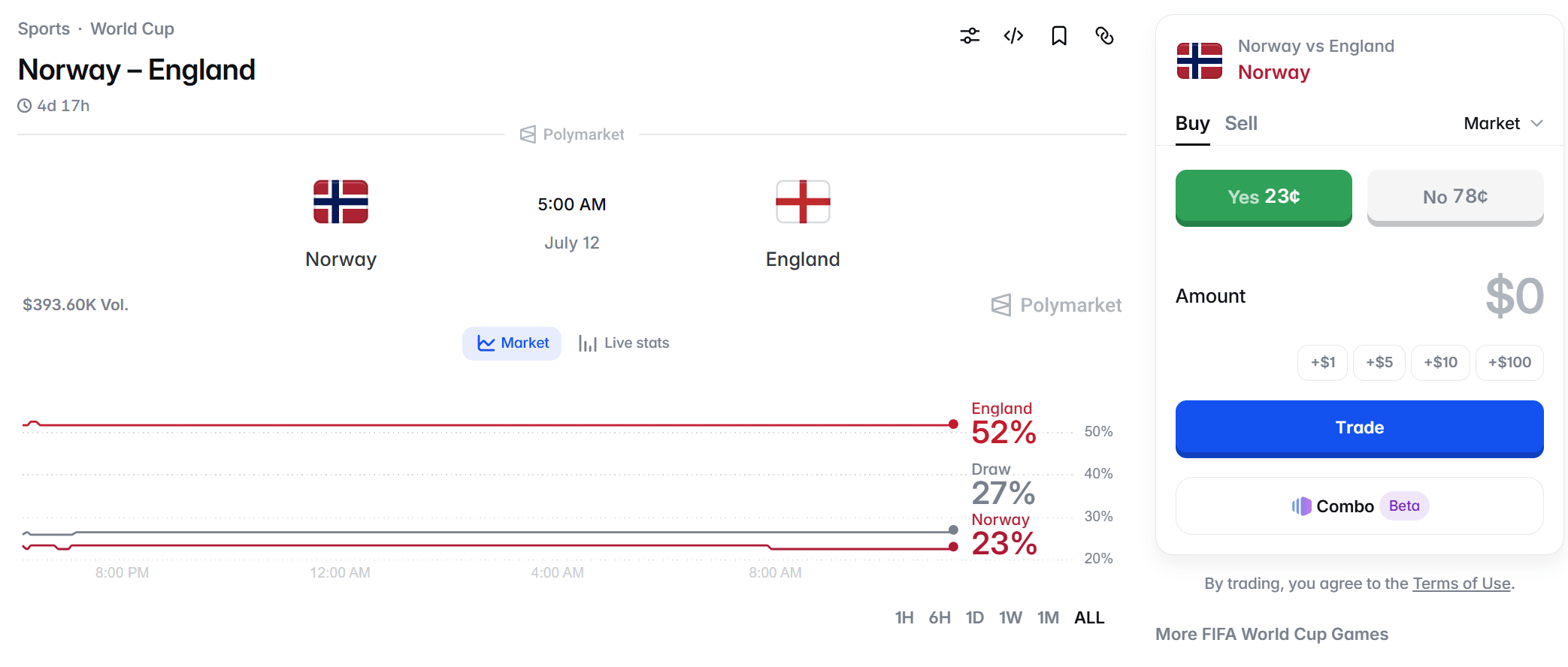
Norway vs England Prediction: Can Haaland Shock England?
Explore Norway vs England prediction, Polymarket crypto odds, Haaland impact, team analysis, and key factors shaping this World Cup clash.

Is Election Prediction Market Betting Legal in the US? The Complete 2026 Guide
Is election prediction market betting legal in the US? Get the full 2026 breakdown of Kalshi vs Polymarket legality, insider trading risks, state bans, and scam warnings. (160 characters)
Prediction Market Regulations: What WEEX Users Should Know Before Trading Event Contracts
Prediction market regulations vary by country, state, event type, and platform structure. This WEEX-style education guide explains the main regulatory issues around event contracts, election markets, sports outcomes, crypto prediction markets, and user risk checks without treating prediction markets as a WEEX trading product.

How to Buy WXT Token: A Beginner’s Guide to WEEX Token Trading
WXT is the native platform token of the WEEX ecosystem. This beginner-friendly guide explains how to buy WXT on WEEX, what to check before trading, how to manage risk, and how users can review WXT’s role within the exchange ecosystem before placing an order.
Is WXT Token a Good Investment? Benefits, Risks, and Key Factors to Watch
WXT may interest users who want exposure to the WEEX ecosystem, but it is still a volatile crypto asset with platform, liquidity, and market-cycle risks. This WEEX-style guide explains how beginners can evaluate WXT’s potential benefits and risks before making any trading decision.

Polymarket vs. Polls: What Prediction Markets Say About the 2026 Midterm Races
Polymarket-style prediction markets and traditional polls measure different things. This WEEX-style market review explains how users can compare election odds, polling data, liquidity, and political risk signals around the 2026 U.S. midterm races without treating prediction markets as a WEEX trading product.
Is Election Prediction Market Legal? State Bans vs. CFTC Lawsuits Explained
Election prediction markets sit between federal derivatives law, state gambling rules, and crypto-native event trading. This WEEX-style guide explains why legality depends on platform structure, jurisdiction, CFTC oversight, and state enforcement, while reminding users to treat election markets as an external regulatory topic rather than a WEEX trading product.

AI Memory Supercycle Debate: Why Big Tech's Margin Panic Just Confirmed SanDisk's NAND Advantage
Why is SanDisk (SNDK) surging in 2026's AI memory supercycle? See how Apple, Microsoft, and Big Tech's margin panic confirmed NAND pricing power, plus Bernstein's $3,000 target, key risks, and what to watch next.
SNDK Stock Dip After Apple's Price Shock: Trap or Last Chance Before $3,000?
SNDK stock dipped 12%+ after Apple's price hike shock — but Bernstein just raised its target to $3,000. Is the SanDisk dip a trap or a buying opportunity? Full analysis with latest data, analyst targets, and risks.
United States Water Reserve (USWR): Can You Buy It Now? Price Outlook and Risk Guide
United States Water Reserve (USWR) has attracted attention because of its water-reserve narrative, but users should first confirm whether the token is actually tradable before looking for a buy route. This guide explains how WEEX users can track USWR, avoid fake links, and evaluate its price outlook with caution.
Is America 250 Coin a Cryptocurrency? Official Commemorative Coin vs Meme Token Explained
America 250 Coin can refer to official U.S. commemorative coinage or unofficial crypto tokens using similar patriotic branding. This guide explains the difference between physical commemorative coins and speculative meme tokens, and what WEEX users should verify before trading any America 250-themed crypto asset.

Gold Crash or Buying Opportunity? What the Market Is Really Telling Us
Gold crash or buying opportunity? Learn why gold prices fell, how Fed policy and crowded trades affect the market, and how PAXG and XAUT fit into tokenized gold trading.
WXT Token Trading Risks: Liquidity, Platform Dependence, and Price Volatility Explained
WXT is connected to the WEEX ecosystem, but traders still need to understand liquidity, platform dependence, volatility, market cycles, and execution risk before entering a position. This guide explains how WEEX users can evaluate WXT with a practical risk framework.

Why Are Prediction Markets Booming? Polymarket, Kalshi, and the On-Chain Trading Narrative
Prediction markets are gaining attention because they turn real-world uncertainty into tradable probabilities. This WEEX-style market review explains why Polymarket, Kalshi, stablecoins, social media, and on-chain trading narratives are pulling more traders toward event-based markets.

Are Prediction Markets Investing or Gambling? Key Regulatory Risks Before Trading
Prediction markets sit between finance, forecasting, speculation, and gambling. This WEEX Wiki article explains why the regulatory line is blurry, what beginners should check before trading event contracts, and why users should treat prediction market odds as external research rather than a WEEX trading product.

QCOM Stock Forecast 2026: Will Qualcomm's AI Push Revalue the Stock?
QCOM stock forecast 2026: Explore Qualcomm’s AI data center push, AI phones, growth drivers, risks, and USDT-based TradFi trading on WEEX.

SpaceX Starlink Launch Vandenberg June 2026: Southern California Visibility Guide
SpaceX Starlink launch Vandenberg June 2026 visibility guide for Southern California with today’s liftoff time, best viewing areas, weather-based outlook, and live update details.
SpaceX Starlink Launch Vandenberg: Live Updates and Liftoff Time for Today
SpaceX Starlink launch Vandenberg live updates and liftoff time for today’s launch. Get the latest timing, Starlink 17-28 details, 24-satellite payload info, and current countdown updates.
Why SpaceX and OpenAI IPOs Are Draining Bitcoin Liquidity
Why SpaceX and OpenAI IPOs are draining Bitcoin liquidity in 2026, including IPO flow impact, BTC ETF outflows, AI stock rotation, and market implications.
Is SpaceX IPO a Good Investment? SpaceX Stock, Valuation, Risks & Future Growth Explained
Is SpaceX IPO a good investment? Explore SpaceX stock valuation, Starlink growth, IPO risks, future potential, and whether buying SpaceX shares makes sense in 2026.
What Is Project Oasis Coin (PXR) Crypto? Latest 2026 Guide to PXR Price, Solana Contract And More
What is Project Oasis Coin (PXR) crypto? Read the latest 2026 guide to PXR price, Solana contract, market cap, legitimacy, risks, and how to trade safely.
Rardden Token AI Transaction Framework: Why It Matters in 2026
Why Rardden Token is introducing a new AI transaction framework, what RDN claims to solve, latest project update, risks, contract details, and AI crypto insights.

USWR Price Prediction: Can United States Water Reserve Hit $1?
Can United States Water Reserve hit $1 in 2026? USWR has started attracting attention because it combines several powerful crypto narratives: Solana tokens, AI infrastructure, water demand, real-world asset language, and scarcity around natural resources. That mix can create strong market interest, but it also makes careful research more important.
Can CDOF Reach $1 in 2026? Chinese Digital Oil Fund Price Prediction
Can CDOF reach $1 in 2026? That question has started appearing because Chinese Digital Oil Fund, or CDOF, has gained attention as a Solana-based token with an energy-themed narrative. The name sounds serious, but traders should separate the branding from the actual market structure before making any price prediction.

Can XRP Reach $10 in 2026? XRP Price Prediction and Market Cap Analysis
Can XRP reach $10 in 2026? It is one of the most searched questions around large-cap crypto assets because XRP has a long market history, deep liquidity, and one of the strongest brand names in digital assets. But a $10 target is not just about popularity. It depends on supply, valuation, market demand, XRP Ledger adoption, and whether the broader crypto market can support another major altcoin expansion.
Futu Penalty Shock Exposes Brokerage Risk — Why WEEX TradFi Fits Traders Who Want Faster Global Market Access
Futu stock falls after China penalty news. Learn why FUTU shares dropped, how the latest crackdown affects traders, and why WEEX TradFi offers USDT-margined access to stocks, gold, oil, forex, and indices in one account.
France vs Morocco Prediction Crypto Odds
France vs Morocco Prediction Crypto Odds explained. Learn how Polymarket market data, blockchain prediction markets, liquidity, and crypto odds work during FIFA 2026.
Why Does SpaceX Own 18,712 Bitcoin? Here's What SPCX's Nasdaq 100 Entry Means for Crypto
SpaceX owns 18,712 Bitcoin worth $1.2B+. SPCX joined Nasdaq 100 on July 7 triggering $4.3B in passive buying. What it means for crypto and BTC price in 2026.
What Is Aptos (APT) Crypto and How Does It Work? The 2026 Complete Guide
What is Aptos (APT) crypto? Learn how it works, Block-STM tech, tokenomics, April 2026 reforms, current price, ecosystem, and whether APT is a good investment in 2026.
Where and How to Buy MSTR Futures: A Complete Trading Guide
Learn where and how to buy MSTR Futures, explore traditional stock access methods, and discover USDT-based MSTR price exposure through WEEX TradFi trading. Join the TradFi Trading Challenge for potential rewards.
Norway vs England Prediction: Can Haaland Shock England?
Explore Norway vs England prediction, Polymarket crypto odds, Haaland impact, team analysis, and key factors shaping this World Cup clash.
Is Election Prediction Market Betting Legal in the US? The Complete 2026 Guide
Is election prediction market betting legal in the US? Get the full 2026 breakdown of Kalshi vs Polymarket legality, insider trading risks, state bans, and scam warnings. (160 characters)